CELPIP Speaking · free template
CELPIP Speaking Task 4: Making Predictions
CELPIP Speaking Task 4 shows the same picture as Task 3 and gives you 30 seconds to prepare and 60 seconds to say what you think will happen next.
The scoring is in the speculation language: will, going to, might, probably, I imagine. The framework below organizes the answer around the people you described in Task 3, predicting one next step for each and giving a reason from the picture.
- Preparation
- 30 seconds
- Speaking time
- 60 seconds
- Format
- Predict what happens next in the Task 3 picture
The template
Describe
Ground the prediction in what is actually visible.
“The clouds have darkened and the family are packing the picnic away.”
Project
Move forward in time explicitly.
“In a few minutes they will probably be back in the car.”
Hedge
Predictions are graded on hedging as much as on content.
“It is likely, though the storm may pass to the north.”
A real prompt, with model answers
This is a free exercise from the Speaking Task 4 question bank, shown with its scored model answers - the same responses learners compare against after submitting. Read the prompt, try answering with the template above, then see how the three levels differ.
Speaking Task 4 prompt
Loading the Last Crate
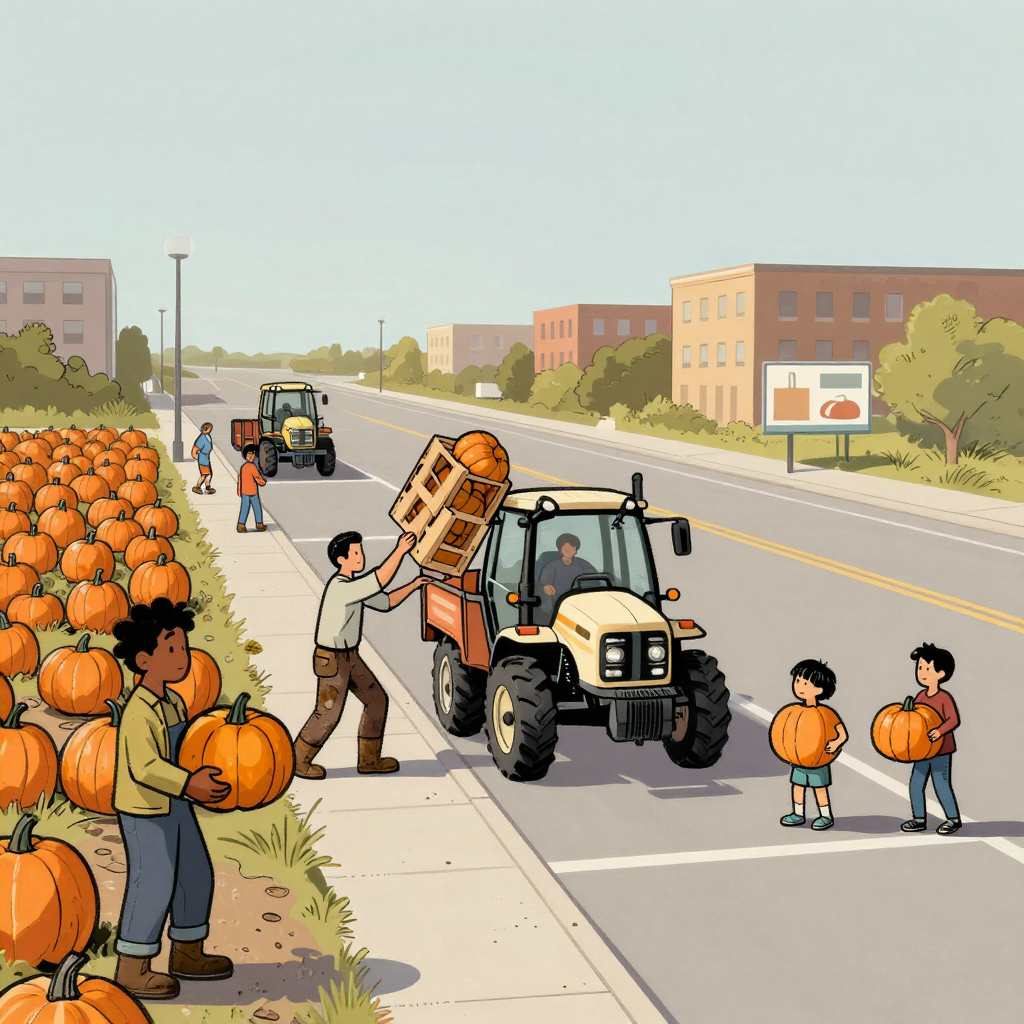
In this picture, what do you think will most probably happen next?
Basic responseestimated CELPIP level 5
In this picture, I think the box will fall down. The tractor is moving already, and the two men, they still hold the crate. It is very heavy, so maybe they cannot put it on the trailer. The pumpkins will drop on the ground and some of them will break. The men will shout to the driver, but I think he does not hear, because he is looking in front of him. After a few seconds he will stop the tractor. Then they must pick up all the pumpkins again. The children in the rows behind, maybe they come and help too. It is not a big accident, only they lose some time.
What works: The prediction is clear and the speaker names both the cause and the result in simple, understandable sentences.
What holds it back: Sentence patterns repeat and there are grammar slips such as 'the two men, they still hold' and 'maybe they come and help'.
Good responseestimated CELPIP level 8
Well, in this picture I would say the crate is about to fall. The tractor has already started moving forward, but the two workers have not finished lifting that last crate onto the flatbed, so the trailer is basically pulling away from them. You can see the crate tipping to one side as they stretch after it. Most probably one of them will lose his grip and the pumpkins will roll out onto the ground. After that, I think the workers will shout, and the driver will stop and back up, because right now he is facing forward and has not noticed anything. Then they will have to gather all the pumpkins again, and the children picking further down the rows will probably run over to see what happened. Nobody will get hurt, but they will lose a few minutes at the end of the day.
What works: One clear impending event is identified and followed through to a sensible chain of consequences.
What holds it back: The vocabulary stays fairly plain, and a couple of sentences begin the same way with 'After that' and 'Then'.
Excellent responseestimated CELPIP level 11
Looking at this, the most likely thing is that the last crate never makes it onto the trailer at all. The tractor is already rolling forward and the driver has his back to the loading, so the gap between the workers and the tailgate is widening every second. The two of them are stretched right out at arm's length as it is, and you can see the crate tilting badly on the near corner, so I would say that within a second or two someone's grip slips and the whole thing comes down. The pumpkins will spill across the row, and a few of them will probably split open, since they are being lifted at chest height. What happens after that is fairly predictable. Somebody will shout, the driver will finally hear them over the engine and hit the brakes, and the whole crew will end up crouched in the dirt sorting the good pumpkins from the broken ones. The children working further down the rows will almost certainly abandon their own picking and come running over to watch, which will slow things down even more just when everyone is trying to finish before dark.
What works: Natural spoken idiom, precise detail from the scene, and a well-reasoned sequence of outcomes that fills the full response time.
What holds it back: The closing chain of consequences runs slightly long and could crowd out the main prediction if delivered quickly.
Put the template to work
Reading a structure is the easy half. Rehearse Speaking Task 4 against the real clock with exam-style prompts and instant feedback.
Practice Speaking Task 4Speaking Task 4 - common questions
- Can my prediction be wrong?
- There is no wrong prediction - the picture has no official future. What raters assess is whether the prediction is grounded in something visible ("the sky is dark, so…") and expressed in accurate future and modal forms.
- How is Task 4 different from Task 3 if the picture is the same?
- Task 3 is description in the present; Task 4 is speculation about the future. Repeating description in Task 4 scores as off-task. The pivot phrase to rehearse: "In a few minutes, I think…".
- Which grammar should I show off in Task 4?
- A range of future forms: "will" for confident predictions, "is going to" where the picture shows evidence, "might / could" for possibilities, plus a conditional if you can ("If the rain starts, they will…"). Using only "will" for the whole minute undersells your range.