CELPIP Speaking · free template
CELPIP Speaking Task 3: Describing a Scene
CELPIP Speaking Task 3 shows you a picture and gives you 30 seconds to prepare and 60 seconds to describe it to someone who cannot see it.
The trap is darting around the image at random. The framework below imposes an order - overview first, then the main people or action, then the surroundings - so the listener can rebuild the scene, which is precisely what the task instruction asks for.
- Preparation
- 30 seconds
- Speaking time
- 60 seconds
- Format
- Describe a picture to someone who cannot see it
The template
Foreground
Start with what dominates the frame and work backwards.
Background
Place the setting only after the subject is established.
Detail
Two specific details beat ten general ones.
A real prompt, with model answers
This is a free exercise from the Speaking Task 3 question bank, shown with its scored model answers - the same responses learners compare against after submitting. Read the prompt, try answering with the template above, then see how the three levels differ.
Speaking Task 3 prompt
Rainy Morning Bus Stop
Describe some things that are happening in the picture below as well as you can. The person with whom you are speaking cannot see the picture.
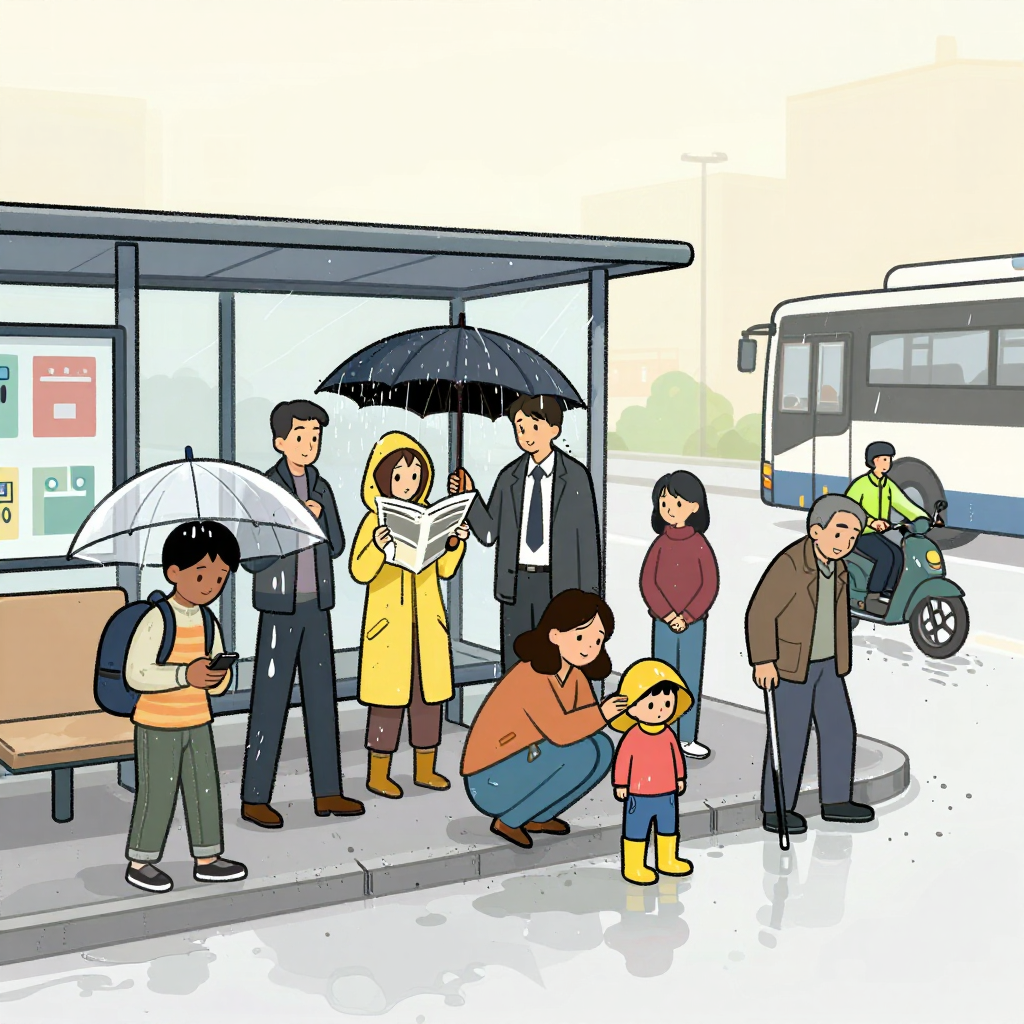
The person with whom you are speaking cannot see the picture.
Basic responseestimated CELPIP level 5
Okay, so, um, this picture is a bus stop and it is raining. The ground is wet. There are many people waiting. One woman has a yellow coat and she puts a newspaper on her head because of the rain. A man has an umbrella, a black one, and he is shaking it. There is a boy with a backpack, he looks at his phone. His bag is very wet, I think. A mother is with a small child. She puts the hood on the child's head. The child has boots. There is an old man too, he has a stick, um, a cane, and he looks at the road. A bus is coming and it makes water splash. Behind them there is a man on a bicycle with a bright vest. Everybody is waiting. It looks cold and, um, not very happy.
What works: Covers most of the people in the scene and stays on task for the full time.
What holds it back: Sentences are short and repetitive, with little spatial detail to help a listener picture where things are.
Good responseestimated CELPIP level 8
So the picture shows a really crowded bus stop on a rainy morning in the city. Everything looks grey and the sidewalk is soaked, with puddles right along the curb. Under the glass shelter there's a woman in a bright yellow raincoat, and she's holding a folded newspaper over her head, which probably isn't helping much. Next to her a man in a suit is shaking the water off his black umbrella before he steps in. In the front there's a teenager with a really wet backpack, and he's just scrolling on his phone under a clear plastic umbrella, not paying attention to anyone. Right beside him a mother is crouching down to pull a rain hood over her little kid, who's wearing rubber boots. At the edge of the group there's an older man leaning on a cane, and he's looking down the street where a bus is coming through a big puddle and splashing water. And behind the shelter there's a delivery cyclist in a bright safety vest with one foot on the curb, waiting to get past.
What works: Clear left-to-right organization with useful location phrases and accurate detail about each person.
What holds it back: Relies heavily on 'there's' to introduce each group, which makes the structure feel a little listlike.
Excellent responseestimated CELPIP level 11
Alright, picture a city bus stop on one of those grey Monday mornings where it hasn't stopped raining since dawn. The sidewalk is completely soaked and there are puddles pooling along the curb, so nobody wants to stand too close to the road. The shelter itself is packed. Under the glass roof there's a woman in a bright yellow raincoat who's given up and is holding a folded newspaper over her head, and right beside her a man in a business suit is shaking the water off a black umbrella before he squeezes in. Closer to me, in the foreground, a teenager with a completely soaked backpack is under one of those clear plastic umbrellas, totally absorbed in his phone. Beside him a mother has crouched down to pull a rain hood over her toddler, who's stamping around in little rubber boots and clearly enjoying the weather more than anyone else. Off to one side an older man is leaning on his cane, watching the street, because a bus is finally coming and it's throwing up a wall of spray as it hits a puddle. And just behind the shelter, a delivery cyclist in a bright safety vest is balanced with one foot on the curb, waiting for a gap so he can get through. It's the kind of scene where everyone is damp, patient and slightly resigned.
What works: Natural spoken idiom, strong sequencing from background to foreground, and an interpretive closing line that ties the scene together.
What holds it back: The interpretive comments about how people feel go slightly beyond what is strictly visible in the picture.
Put the template to work
Reading a structure is the easy half. Rehearse Speaking Task 3 against the real clock with exam-style prompts and instant feedback.
Practice Speaking Task 3Speaking Task 3 - common questions
- Should I describe everything in the picture?
- No - one overview sentence, then two or three areas in detail beats ten items named in a rush. Choose the parts you have vocabulary for and describe those fully: what the people are doing, what they are wearing, what seems to be happening.
- What tense do I describe a picture in?
- Present continuous for actions ("a man is loading boxes"), simple present for states ("the café looks busy", "there are two cyclists"). Slipping into past tense is the most common grammar error on this task.
- What vocabulary should I prepare for Task 3?
- Position language: in the foreground, in the background, on the left, next to, behind, in front of. These phrases organize the whole answer, and they transfer directly to Task 4, which uses the same picture.